Every plant operator in Singapore who uses scaffolding during maintenance, turnarounds, or construction faces the same compliance question: are your scaffold contractors and supervisors meeting SS 659?
Get it wrong, and MOM can stop work on site. Get it right, and you reduce fall-from-height risk, protect your workforce, and keep your operations on schedule.
This post explains exactly what SS 659 covers, who is responsible, what inspections are required, and what plant operators should do before their next scaffold-dependent job.
What Is SS 659 And Who Does It Apply To
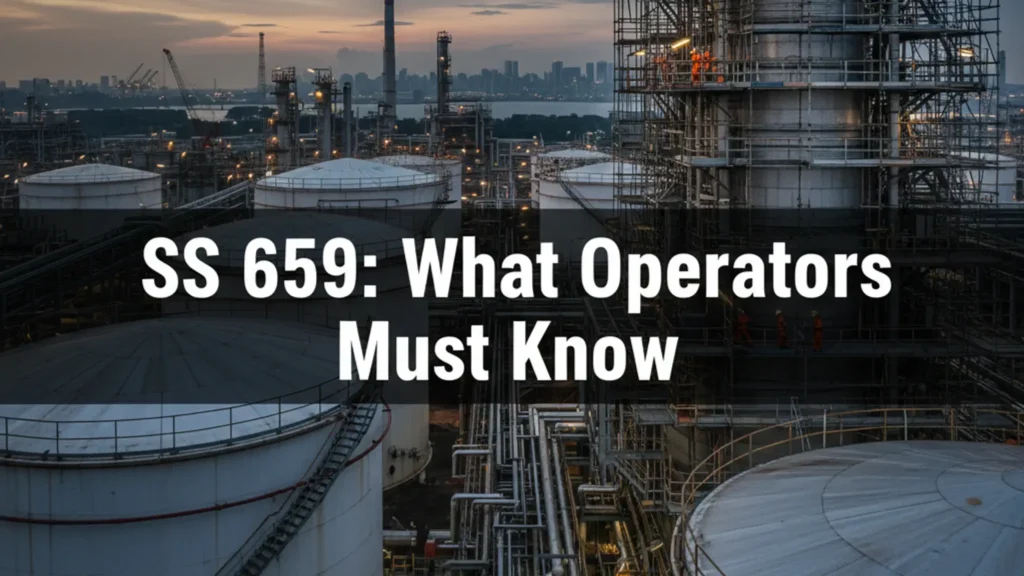
Quick Answer: SS 659:2020 is Singapore’s Code of Practice for Scaffolds, published by Enterprise Singapore and enforced under the Workplace Safety and Health (Scaffolds) Regulations administered by MOM. It applies to any workplace in Singapore where scaffolding is erected, used, altered, or dismantled — including oil and gas facilities, pharmaceutical plants, petrochemical refineries, manufacturing facilities, and marine yards.
SS 659:2020 is the current edition of Singapore’s national scaffold standard. It replaces CP 14:1996 and was approved on 16 June 2020 by the Quality and Safety Standards Committee (QSSC) under the Singapore Standards Council.
The standard is published by Enterprise Singapore and sets out the general provisions for erecting and using scaffolds across industries including construction, marine, process industries, manufacturing, and commercial facilities management. For plant operators in Singapore’s industrial zones, process industries is the directly relevant category.
SS 659:2020 covers the following scaffold types:
- Tube and coupler scaffolds (Section 9)
- Steel frame scaffolds (Section 10)
- Modular scaffolds (Section 11)
- Aluminium tower scaffolds (Section 12)
- Steel tower scaffolds (Section 13)
- Special scaffolds, including suspended and cantilever designs (Section 14)
The standard explicitly excludes rope-suspended platforms (boatswain chairs), power-operated suspended scaffolds, timber scaffolds, formwork supports, and material loading scaffolds.
SS 659:2020 does not replace the Workplace Safety and Health (Scaffolds) Regulations 2011. It works alongside them. The Regulations are the statutory instrument — they carry legal force under the WSH Act. SS 659 is the technical code of practice that defines how to meet those statutory requirements in practice. Both apply at your site.
Key Requirements Under SS 659
Understanding what SS 659 actually requires is where most plant operators have gaps. The standard goes well beyond “put up safe scaffolding.” It specifies stakeholder responsibilities, equipment specifications, foundation requirements, inspection procedures, and fall protection for scaffold erectors.
Stakeholder Responsibilities (SS 659:2020, Section 7)
One of the significant changes in the 2020 edition was the formal inclusion of stakeholder responsibilities. The standard now maps obligations across four parties: the scaffold contractor, the scaffold supervisor, the scaffold erector, and the scaffold user (the plant operator or employer who commissions the scaffold).
As a plant operator, you are a scaffold user under SS 659. That means you carry defined responsibilities. These include ensuring the scaffold is appropriate for the work, not overloading platforms beyond their rated capacity, and not using any scaffold that has not been inspected and labelled as safe for use.
Equipment Standards (Section 4)
All scaffold tubes, couplers, base plates, and boards must comply with the relevant material specifications referenced in SS 659. For steel tube and coupler scaffolds, materials must meet SS 311. Aluminium tower scaffolds must meet BS EN 1004, BS 1139-6, BS EN 1298, or BS EN 12810, depending on configuration.
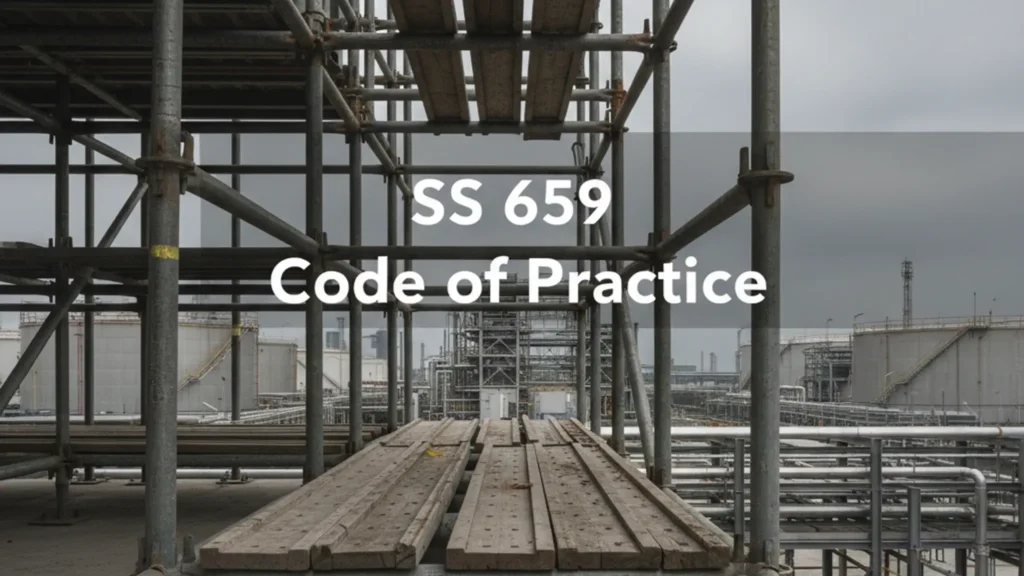
Scaffold boards and platforms must be in sound condition. Boards with visible cracks, splits, or excessive wear must be removed from use.
Scaffold Inspection and Labelling (WSH Scaffold Regulations, Reg 26 and 27)
Under the WSH (Scaffolds) Regulations, every scaffold must be inspected before use and at defined intervals during its deployment. The inspection must be carried out by a competent person — typically a registered scaffold supervisor. After each inspection, the scaffold must be labelled to show its current status: safe for use, incomplete (not for use), or unsafe.
The label system is not optional. An unlabelled scaffold is effectively a non-compliant scaffold. MOM inspectors check for this during site visits.
Foundation and Tie Requirements
SS 659 requires scaffold foundations to be stable and capable of carrying the imposed loads. On industrial plants, this often means verifying the bearing capacity of existing ground or structural supports before erection. Section 5 of the standard addresses this directly. Ties connecting scaffolding to the plant structure must comply with Regulation 31 of the WSH (Scaffolds) Regulations and Section 15 of SS 659.
How SS 659 Relates To MOM Regulations
SS 659 sits within a wider regulatory framework that gives MOM enforcement authority over scaffold safety in Singapore. Understanding this relationship matters for plant operators because it determines what MOM can actually do if your site is non-compliant.
The WSH Act and Scaffold Regulations
The Workplace Safety and Health Act (Cap. 354A) is the primary legislation. Under it, the WSH (Scaffolds) Regulations 2011 set out specific duties for the responsible person, the scaffold contractor, the scaffold supervisor, and the scaffold user. These Regulations carry legal force.
Under Regulation 4, every scaffold that forms part of a workplace where more than 5 workers are engaged at any one time — or where work will be carried out at height — must be erected, altered, and dismantled by an Approved Scaffold Contractor. You cannot engage a general contractor who is not specifically approved for scaffolding work on MOM-regulated sites.
Approved Scaffold Contractors
Regulation 57 of the WSH (Scaffolds) Regulations defines the approval process for scaffold contractors. The contractor must hold a valid certificate of approval issued by MOM. As a plant operator, it is your responsibility to verify this before awarding a scaffold contract. Engaging an unapproved contractor exposes the occupier of the workplace to enforcement action.
Competency Requirements for Supervisors and Erectors
Every scaffold must have a designated scaffold supervisor with the required WSH certification. Scaffold erectors must have completed the relevant competency course and have minimum documented experience. Both roles are mapped to specific training frameworks under WSH (Scaffolds) Regulations Regulations 5 and 6.
MOM inspections increasingly cross-reference training records with site personnel. Having an erector on site without current documentation is a finding.
Penalties and Enforcement
Non-compliance with the WSH Act carries penalties of up to SGD 500,000 for a body corporate and up to SGD 200,000 or imprisonment for individuals in the case of a serious breach. For scaffold-related fatalities or serious injuries, MOM investigations routinely review SS 659 compliance and scaffold inspection records as part of determining liability.
Beyond penalties, MOM inspectors have the power to issue stop-work orders. In industrial plants where scaffolding supports ongoing maintenance or a turnaround, a stop-work order has immediate schedule and cost consequences.
What Plant Operators Should Do Before Their Next Scaffold Job
Most SS 659 failures in Singapore industrial plants are not caused by deliberate non-compliance. They come from gaps in pre-job verification. The following steps address the most common findings.
1. Verify your contractor’s MOM approval status. Request the current certificate of approval from your scaffold contractor before mobilisation. Check the validity date and scope. A lapsed or narrow-scope certificate is a common gap. Regulation 59 of the WSH (Scaffolds) Regulations requires the contractor to produce this certificate on request.
2. Confirm scaffold supervisor certification. Ask for the name and certification records of the designated scaffold supervisor before work starts. The supervisor must hold a valid WSH-recognised qualification and have site-specific experience.
3. Review the scaffold design documentation. For any work platform used by more than 2 persons per bay, or supporting tools and materials exceeding 25 kg per bay, a Professional Engineer’s design is required under Regulation 20 of the WSH (Scaffolds) Regulations. If your scaffold falls into this category, verify the PE-certified drawings are on site before erection begins.
4. Confirm the inspection and labelling procedure. Before any scaffold is used, confirm your contractor has a documented inspection protocol aligned with the WSH (Scaffolds) Regulations Regulation 26. The label must be attached to the scaffold’s access point, showing the date of inspection and the inspector’s name or reference.
5. Maintain a scaffold register. SS 659 Annex C provides a sample scaffold register format. Keeping a register of all scaffolds on site — with erection dates, inspection dates, modification records, and dismantling dates — is standard practice for audit readiness. In a plant with multiple active scaffolds during turnaround, this register is often reviewed by MOM inspectors.
6. Check load ratings before using platforms for equipment storage. Overloading scaffold platforms is one of the most common causes of scaffold collapse on industrial sites. Every platform has a stated safe working load (SWL). Verify it matches your intended use before placing equipment, materials, or multiple workers on the deck.
7. Engage a specialist scaffolding contractor with industrial experience. General construction scaffolding and industrial process plant scaffolding are different. Industrial work involves working around live piping, rotating equipment, and process vessels under pressure. A contractor experienced in oil and gas, petrochemical, and pharmaceutical environments understands these constraints and how they affect scaffold design and erection. For more on scaffolding and insulation services for industrial plants, see our service page.
Frequently Asked Questions
What is SS 659 in Singapore? SS 659:2020 is Singapore’s Code of Practice for Scaffolds, published by Enterprise Singapore under the Singapore Standards Council. It sets out technical requirements for scaffold design, materials, erection, inspection, and use across all industries including process plants, marine yards, and manufacturing facilities. It replaced CP 14:1996 and was last revised in 2020.
Is SS 659 a legal requirement in Singapore? SS 659 is a code of practice, not a regulation. However, it is the recognised technical standard supporting the Workplace Safety and Health (Scaffolds) Regulations 2011, which are legally binding under the WSH Act. Non-compliance with SS 659 guidance is routinely referenced in MOM investigations when assessing whether the WSH Act’s duty of care obligations were met.
Does every scaffold in Singapore need an Approved Scaffold Contractor? Under the WSH (Scaffolds) Regulations Regulation 4, scaffolding at workplaces meeting certain size and worker thresholds must be erected by an MOM-approved scaffold contractor. For most industrial plants in Singapore, this requirement applies. Plant operators should verify contractor approval status before commencing any scaffold work.
How often must scaffolding be inspected under SS 659? Scaffolding must be inspected before first use and after any modification, adverse weather event, or event that may have affected structural integrity. The inspection must be carried out by a competent person. After inspection, the scaffold must be labelled under WSH (Scaffolds) Regulations Regulation 27. On long-duration turnarounds, regular re-inspection at intervals agreed with your scaffold contractor is standard practice.
What qualifications does a scaffold supervisor need in Singapore? Under the WSH (Scaffolds) Regulations, a scaffold supervisor must hold a valid WSH-recognised qualification. Supervisors are required to complete approved training through accredited providers before taking responsibility for scaffold erection or supervision on a regulated worksite.
What happens if scaffolding at my plant fails a MOM inspection? MOM inspectors can issue improvement notices, stop-work orders, or initiate prosecution under the WSH Act. For a corporation, fines can reach SGD 500,000. Beyond regulatory penalties, a stop-work order during a planned turnaround causes direct schedule and cost impact. Audit-ready documentation, approved contractors, and compliant inspection records are the most reliable way to avoid these outcomes. Bukom’s approach to asset integrity management and compliance support includes verifying that regulatory requirements are met before and during work execution.
Staying Compliant With SS 659 Is an Operational Decision
SS 659 compliance is not a paperwork exercise. It is the difference between a turnaround that runs on schedule and one that gets stopped. For plant operators on Jurong Island and across Singapore’s industrial corridors, the scaffold standard affects every job where access at height is required.
Three things matter most:
- Your scaffold contractor must be MOM-approved, with current certification on file before mobilisation.
- Every scaffold must be inspected, labelled, and registered before your crew uses it.
- Design documentation from a Professional Engineer must be on site for any platform carrying significant loads or multiple workers.
Bukom Engineering’s scaffolding and insulation services are designed for industrial plant environments in oil and gas, pharmaceutical, and petrochemical sectors. Our teams work within the regulatory requirements of SS 659 and the WSH (Scaffolds) Regulations, and we support plant operators with documentation, inspection records, and compliance-ready scaffold delivery.
For a scope assessment or to discuss your next maintenance window or turnaround, contact us directly.