Which code you need. What it covers. How to plan inspections without shutdown surprises
Singapore plants do not lose money because “standards are confusing.” They lose money when a small integrity issue turns into an unplanned scope increase during a tight shutdown window. If your team is juggling pressure vessels, process piping, and storage tanks, these three API codes are the most common reference points for how inspection and repair decisions get made.
This guide breaks down what each code is for, how to map them to your assets, and how to plan inspection work in a way that reduces rework and avoids documentation panic right before audits.
What are API 510, API 570, and API 653 and which one applies to your equipment?
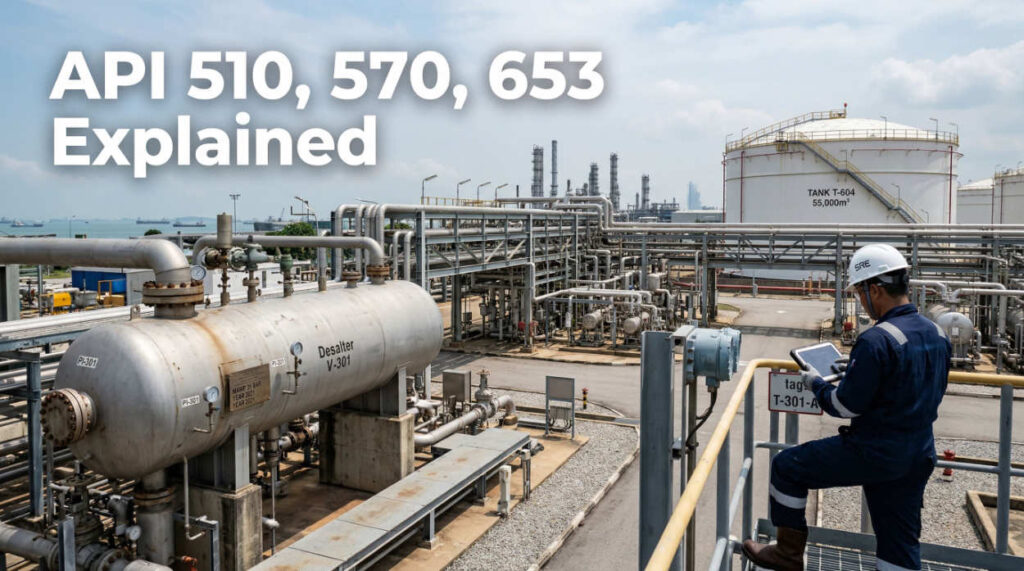
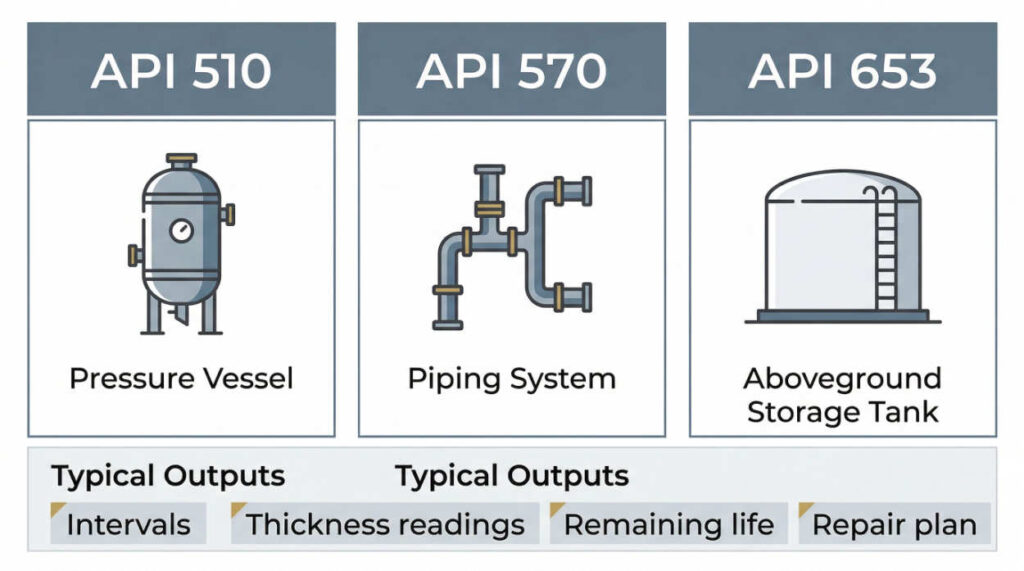
[Answer Capsule] API 510 applies to in service pressure vessels and their pressure relieving devices. API 570 applies to in service piping systems and related pressure relieving devices. API 653 applies to aboveground storage tanks built to API 650. In Singapore, pair these codes with a disciplined inspection plan, clean records, and a scope that matches your damage mechanisms so shutdown work stays predictable. ([API][1])
Why these three codes show up in Singapore plants so often
These codes show up because they cover the assets that most often drive integrity risk and shutdown scope.
- API 510 focuses on pressure vessels and the devices that protect them. It covers inspection, repair, alteration, and rerating of vessels that are already in service. ([API][1])
- API 570 focuses on piping systems in service, including inspection, repair, alteration, and rerating. It also calls out inspection intervals and how to evaluate and record inspection data. ([API][2])
- API 653 focuses on aboveground storage tanks, especially tanks built to API 650, and sets minimum requirements for maintaining integrity after the tank is in service. ([API][3])
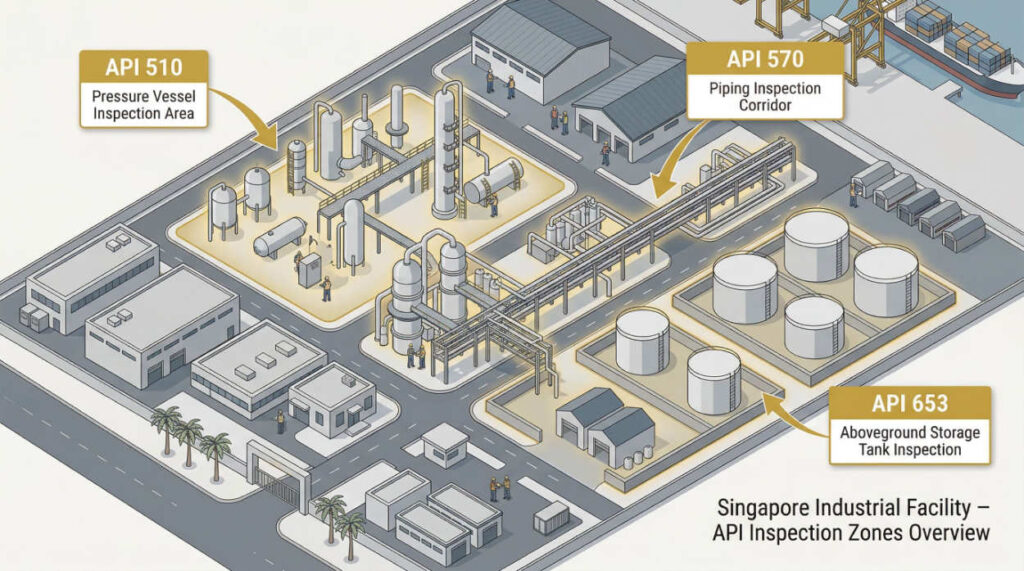
If you want a simple rule: vessel is usually 510, piping is usually 570, tank is usually 653. The mistakes happen in the grey areas. Examples include pressure relieving devices tied to piping, or a tank system with attached piping that gets managed by separate owners.
Quick mapping guide. Pressure vessels vs piping vs tanks
Here is a practical mapping table your ops team can actually use.
| Asset in your facility | The API code that usually applies | What you should expect to produce |
|---|---|---|
| Separator, receiver, drum, filter housing, reactor vessel | API 510 ([API][1]) | Inspection plan, thickness readings at repeatable locations, remaining life, repair or alteration plan |
| Process piping, utility piping, buried piping, piping circuits | API 570 ([API][2]) | Piping circuits, inspection intervals, corrosion rates, assessment of findings, repair scope |
| Aboveground storage tank, tank bottom, shell, foundation interface | API 653 ([API][3]) | Tank inspection plan, settlement and bottom condition focus, repair and reconstruction decisions |
A Singapore specific reality check
Even if your integrity program is strong, you still need to respect local statutory requirements for pressure vessels. Singapore requires pressure vessels to be registered and inspected under MOM processes, and owners typically need an Authorised Examiner involved. ([Ministry of Manpower Singapore][4])
That does not replace API. It changes your documentation discipline and your inspection planning rhythm.
Inspection interval planning. What changes the frequency in real life
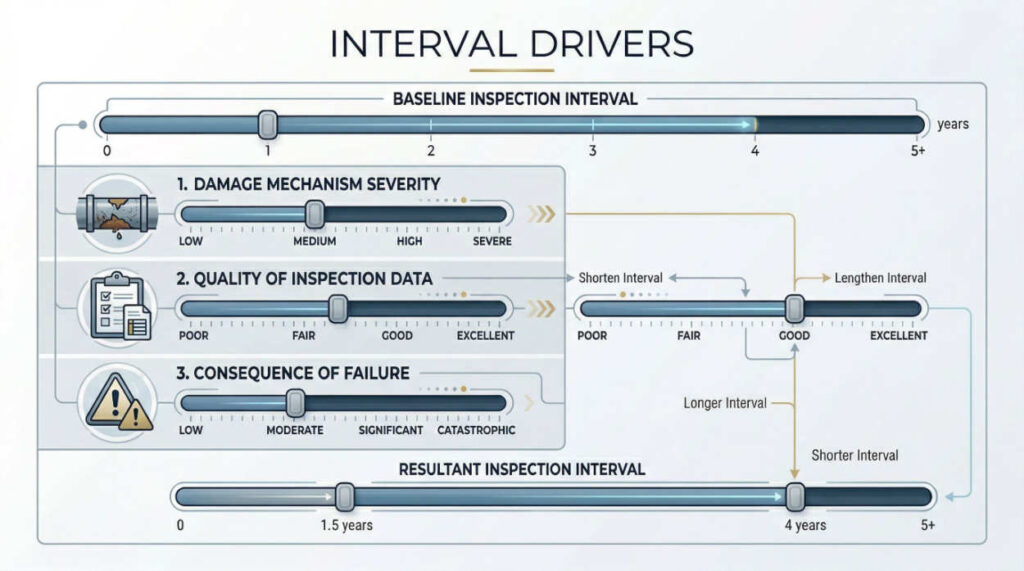
The biggest trap is thinking inspection intervals are a fixed calendar rule. In practice, intervals tighten or loosen based on the damage mechanisms you actually have, and whether your inspection data can prove remaining life.
API aligned thinking pushes you toward three habits:
- Define damage mechanisms per circuit or per vessel zone
- Measure thickness consistently at repeatable locations
- Use those numbers to calculate remaining life
Bukom’s own asset integrity content calls out this practical approach for pressure vessels under API 510, including defined intervals, damage mechanism identification, repeatable thickness measurement, and remaining life calculations. ([Bukom Engineering][5])
What tends to shorten intervals in Singapore conditions
Singapore conditions tend to amplify a few classic issues:
- Persistent humidity and wet insulation risk that supports corrosion under insulation on hot and warm lines
- Marine exposure for coastal assets and tank farms
- High thermal cycling in units that run aggressive start stop patterns
You do not need to guess. You need a circuit strategy and an inspection history that makes your next interval defensible.
A documentation point that saves real time
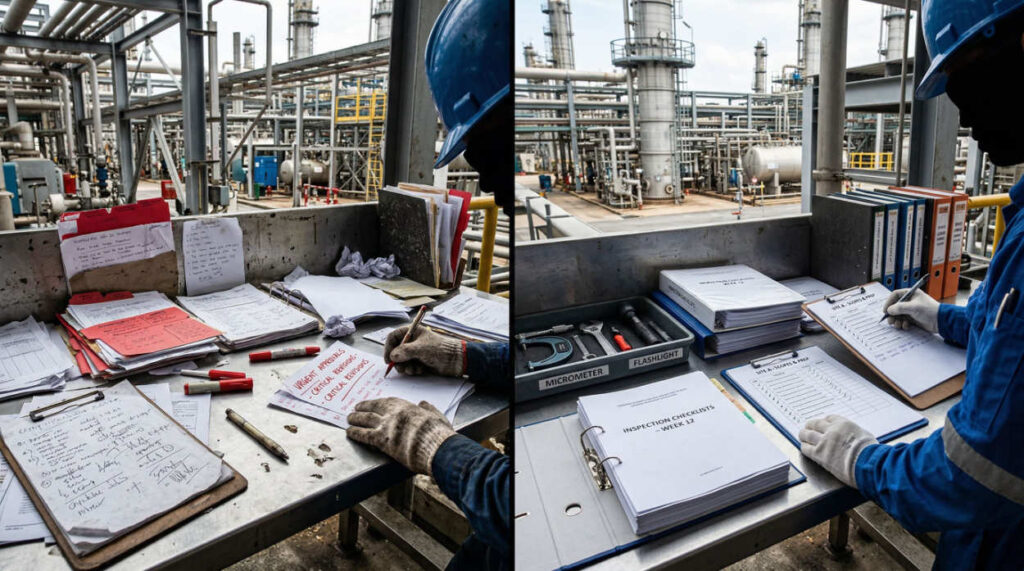
When documentation is messy, teams waste shutdown hours answering basic questions like these.
- What was the last thickness reading and where was it taken
- What changed since the last run
- What was repaired and how was it approved
API 570 training outlines the importance of inspection data evaluation, analysis, and recording. That is not paperwork fluff. That is what keeps repairs from turning into scope creep. ([API][6])
Common compliance mistakes that trigger rework during audits
Audits rarely fail because a team did zero work. They fail because the work is not traceable.
Here are the mistakes that repeatedly cause painful rework.
Mistake 1. Treating API codes like labels, not systems
A label says “this is piping so it is API 570.” A system approach says “this piping circuit has a clear damage mechanism, inspection locations, and a remaining life story.”
API 510 and API 570 both explicitly tie inspection to in service assets and to repair and alteration decisions. If your reports do not connect findings to decision logic, your audit questions will not stop. ([API][1])
Mistake 2. Mixing statutory requirements and API thinking
Pressure vessels in Singapore carry statutory obligations that you cannot ignore, including registration and inspection using an Authorised Examiner pathway. ([Ministry of Manpower Singapore][4])
API can strengthen your integrity program, but you still need to keep your statutory record trail clean and available.
Mistake 3. Thin inspection planning before shutdowns
If you plan inspection late, you end up with two bad options.
- Rush NDT and accept weak coverage
- Discover major findings too late and explode the repair scope
In Singapore, where shutdown windows are tight and manpower planning matters, late discovery often becomes the most expensive kind of discovery.
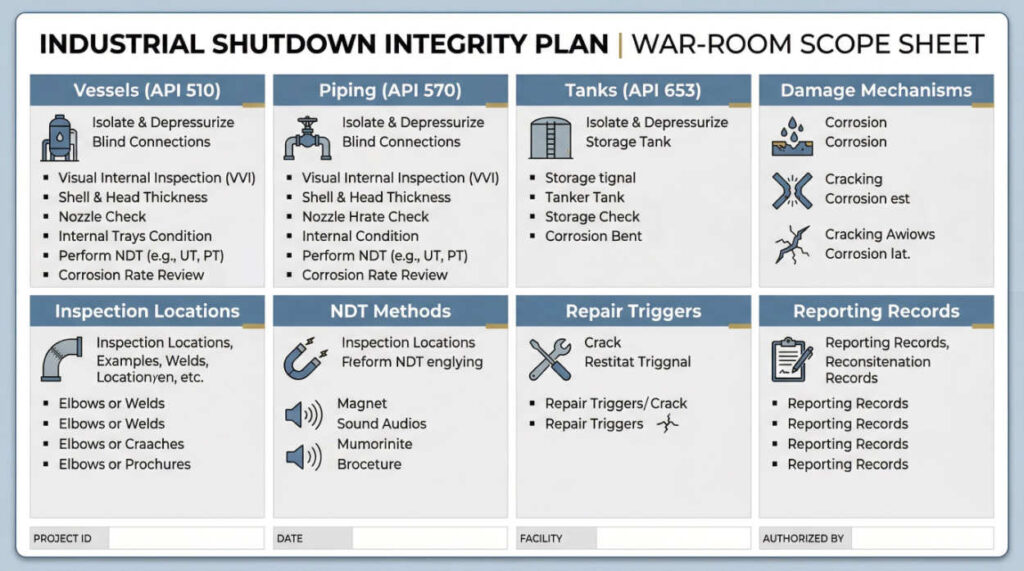
What a good inspection scope looks like before a shutdown window
A good scope is not “inspect everything.” A good scope is “inspect what matters, in the right places, with clear acceptance criteria, and with a repair plan ready.”
Use this pre shutdown checklist as a starting point.
Pre shutdown scope checklist
- List equipment by type. Vessels, piping circuits, tanks
- Assign the API code reference per asset group. 510, 570, 653
- Confirm damage mechanisms. Corrosion, erosion, cracking, CUI risk, settlement risk
- Define inspection locations. Repeatable points for thickness and repeatable features for visual checks
- Decide inspection methods. Visual, UT thickness, profile radiography where suitable, other NDT based on risk
- Define decision thresholds. What triggers repair, what triggers monitoring, what triggers rerating
- Confirm reporting format and record storage so your next cycle starts stronger than this one
If you manage tanks, scope should not ignore cleaning and access realities. Bukom highlights tank cleaning, inspection, and calibration as part of its services, including coverage from bunker fuel tanks to water reservoirs. ([Bukom Engineering][7])
If you manage mixed marine and industrial assets, Bukom also describes reporting aligned with API and IMO within its marine and industrial maintenance service framing. ([Bukom Engineering][8])
Why Bukom Engineering for API linked inspection support
Plant teams do not hire an inspection partner for “more reports.” They hire one for fewer surprises and faster decisions.
Bukom positions itself as a Singapore based engineering firm supporting plant and industrial work, including shutdown and maintenance oriented service lines. ([Bukom Engineering][9])
Bukom also frames asset integrity management around corrosion control, inspection, and predictive maintenance strategies across plant facilities. ([Bukom Engineering][10])
What this means in real outcomes
A practical API aligned inspection partner should help you:
- Translate findings into clear repair decisions
- Keep inspection data consistent so remaining life calculations hold up over time
- Reduce shutdown scope changes by planning inspection coverage early
- Deliver records that survive audits without a fire drill
One more credibility indicator is what the market demands from API inspectors. Job listings tied to Bukom reference API 510 and API 570 certifications as expected qualifications for inspection roles. That signals the type of competency the work requires. ([MyCareersFuture Singapore][11])
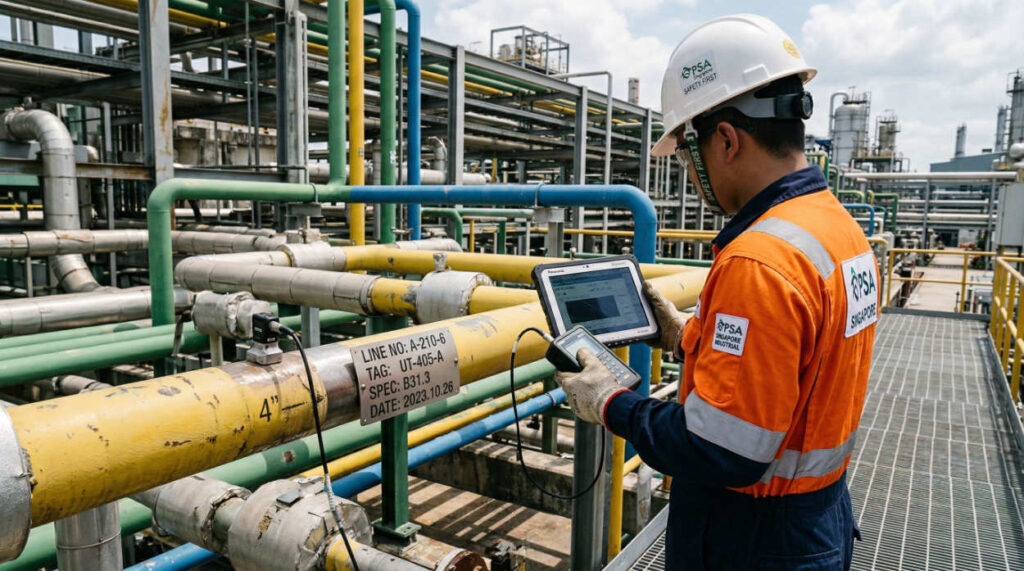
Next steps. Book a review and get a scope checklist
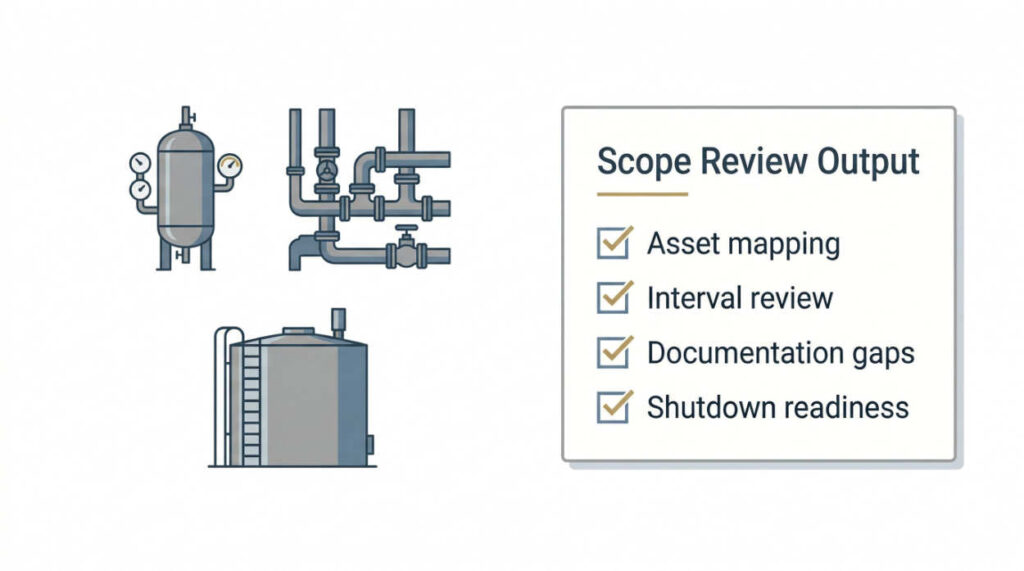
If you want a fast way to reduce risk, start with a short review that answers three questions:
- Which assets fall under API 510, 570, 653 in your facility scope
- Where your inspection history is strong enough to defend intervals
- Where you have gaps that will create shutdown surprises
You can reach Bukom Engineering through its contact channel to request a consult or a scope discussion. ([Bukom Engineering][12])
FAQ
Is API 510 the same thing as Singapore pressure vessel registration rules?
No. API 510 is an inspection code for in service pressure vessels and related devices. Singapore pressure vessel requirements include registration and inspection processes under MOM that involve an Authorised Examiner. Use API to strengthen integrity decisions and use MOM requirements to stay compliant with statutory duties. ([API][1])
Does API 570 cover only metallic piping?
API 570 covers inspection, rating, repair, and alteration procedures for piping systems. It includes metallic piping and also references fiberglass reinforced plastic piping systems in its published scope summary. ([API][2])
What is the fastest way to stop piping inspection from turning into shutdown chaos?
Define piping circuits and repeatable inspection locations early. Record and trend thickness readings. Tie findings to decision thresholds before the shutdown starts. API 570 explicitly emphasizes inspection intervals plus data evaluation and recording. ([API][6])
Does API 653 apply to every tank?
API 653 is written for aboveground storage tanks, especially those built to API 650 and predecessor standards. It focuses on maintaining tank integrity after the tank is in service, including inspection, repair, alteration, and reconstruction topics. ([API][3])
Why do audits often focus on documentation more than the actual NDT?
Because documentation proves that your inspection was planned, repeatable, and decision ready. Without it, you cannot defend intervals or remaining life. API programs place heavy weight on evaluation and recording as part of an integrity system, not as admin work. ([API][6])
What should I prepare before contacting an inspection partner?
Prepare your equipment list, last inspection dates, last thickness readings if available, known damage mechanisms, and your next shutdown window. This allows a partner to propose a scope that fits your timeline instead of reacting late.
Ready to plan ahead instead of scrambling during the next shutdown? Visit our contact page to share your equipment list and inspection details, and Bukom Engineering can help you review the scope early and prepare a practical inspection plan that fits your timeline.