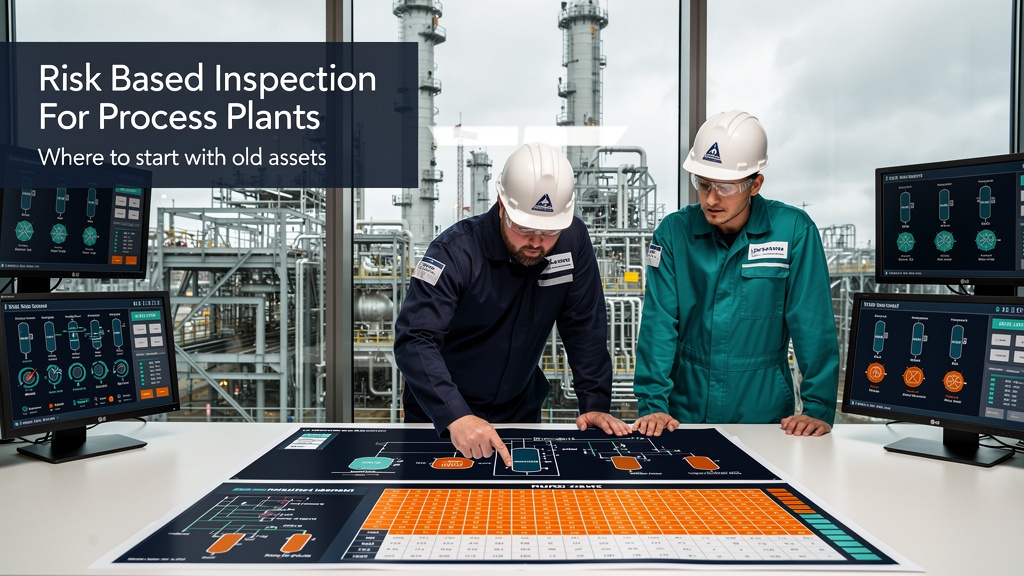
How to start RBI on old assets
Start with what you already have. Pick one unit, clean up the equipment list, define corrosion circuits, and gather basic failure and consequence data. Use RBI to rank risk across static equipment, then move intervals and inspection methods so you spend less time on low risk items and more where failures really hurt. Velosi AIMS
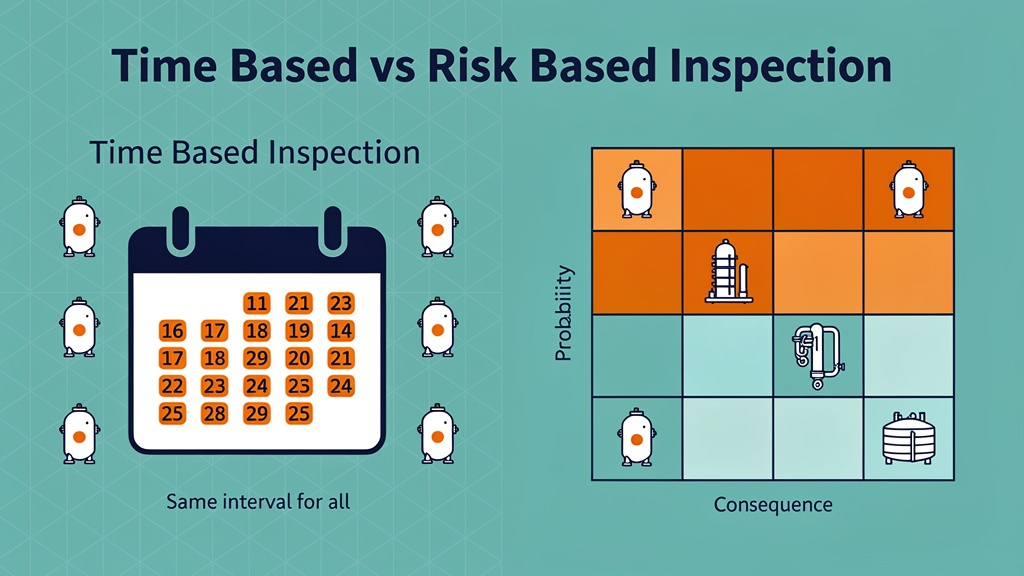
Time based vs risk based inspection for static equipment
Most brownfield plants still run on time based inspection. The schedule is driven by fixed intervals. The task is considered done when the date is met. Cenosco
How time based inspection behaves on old assets
For static equipment like pressure vessels, columns, heat exchangers and storage tanks, time based inspection usually means: Asset Integrity Engineering
- All vessels in a system share the same interval.
- Intervals are often set by a mixture of code minima and history.
- Once on the calendar, items stay there even if service changes.
That is fine for simple, stable service. It becomes painful when:
- One circuit has aggressive corrosion but gets the same interval as a mild circuit.
- You open low risk vessels every shutdown
because we always have
while high risk lines receive little attention.
What risk based inspection actually changes
Risk based inspection uses risk as the driver. Risk is expressed as probability of failure multiplied by consequence of failure. Asset Integrity Engineering
In practice, RBI:
- Ranks static equipment by risk, not only by code or history. Inspectioneering
- Tightens intervals and inspection scope where risk is high.
- Safely relaxes scope and frequency where risk is low.
Time based inspection asks, Did we inspect on time.
Risk based inspection asks, Did we inspect where it matters most.
NWE Group
For brownfield sites, that single shift in mindset is usually where the value appears.
Data you need before RBI is meaningful
RBI software is easy to buy. Good RBI input data is not. On a brownfield plant, the challenge is to be good enough
to rank risk without spending years cleaning every record.
API 580 and common industry practice highlight the same basic ingredients. PetroSync
1. Static equipment register that reflects reality
You need a current list of all static equipment in scope, for example:
- Pressure vessels and columns.
- Heat exchangers and air coolers.
- Storage tanks.
- Piping circuits.
On brownfield plants, this often means reconciling P&IDs, CMMS tags and what is physically in the field. A short targeted field walk with maintenance and inspection leads is usually faster than arguing in Excel.
2. Corrosion circuits and damage mechanisms
RBI is built around how equipment fails. Typical inputs include: ResearchGate
- Defined process circuits with similar chemistry and conditions.
- Temperature, pressure and phase information.
- Expected damage mechanisms such as CO₂ or H₂S corrosion, erosion, CUI or SCC.
You do not need perfect corrosion rates on day one. You do need a shared view of which circuits are more aggressive than others.
3. Condition and inspection history
Useful signals include:
- Previous inspection findings and thickness readings.
- Recorded leaks, failures and near misses.
- Repair history for vessels, exchangers and piping.
If inspection reports are scattered, start with the last one or two turnarounds and any failure investigations. That is usually enough to flag obvious problem circuits.
4. Consequence data
Risk based inspection is not only about corrosion. It also considers what happens when something fails. Opus Kinetic
For a process plant, consequence inputs might include:
- Safety exposure, including inventory, pressure and occupancy.
- Environmental impact, such as emissions or spills.
- Production impact, for example barrels per day or batch capacity lost.
For a first RBI pass, simple consequence categories are often enough. High, medium, low for people, environment and production, combined into a single consequence ranking.
5. Operating context
Finally, old assets rarely live in design conditions. You need a current view of:
- Actual operating envelope vs design.
- Known operating upsets that stress particular circuits.
- Planned changes, debottlenecks, or duty changes.
This is where operations and maintenance supervisors carry knowledge that never made it into drawings. Bring them into the workshop.
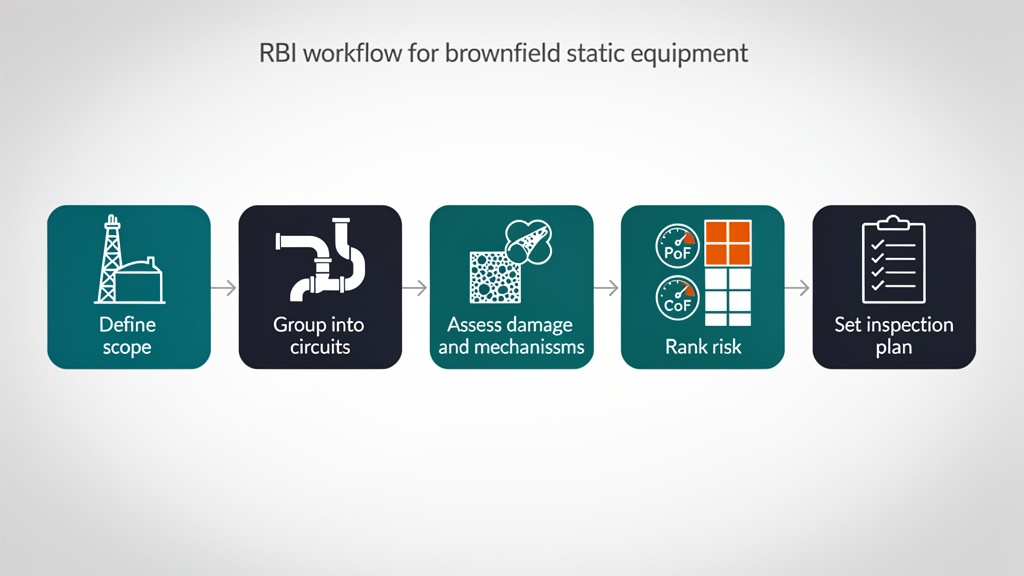
Simple RBI workflow for brownfield static equipment
Once the basic data is in place, you can run a very focused RBI cycle on a unit or system. Most practitioners follow a structure in line with API 580 and similar guides. PetroSync
A practical sequence for brownfield plants looks like this.
Step 1: Choose a narrow scope
Pick one process unit, one tank farm, or one group of steam systems. Trying to RBI the whole plant
from day one usually stalls.
Step 2: Group equipment into circuits
Work with process and corrosion specialists to define corrosion circuits. Group vessels, exchangers and piping that see similar fluid and conditions.
Step 3: Identify damage mechanisms and estimate probability
For each circuit or item: Asset Integrity Engineering
- Confirm expected damage mechanisms.
- Use available data to estimate probability of failure range, often on a 1 to 5 scale.
- Validate any
very low
orvery high
calls with the team.
If you have limited data, be conservative on circuits that have poor visibility or history.
Step 4: Estimate consequence of failure
For each item, rate consequence on the same kind of scale, using your agreed safety, environment and production criteria. Opus Kinetic
Step 5: Rank items on a risk matrix
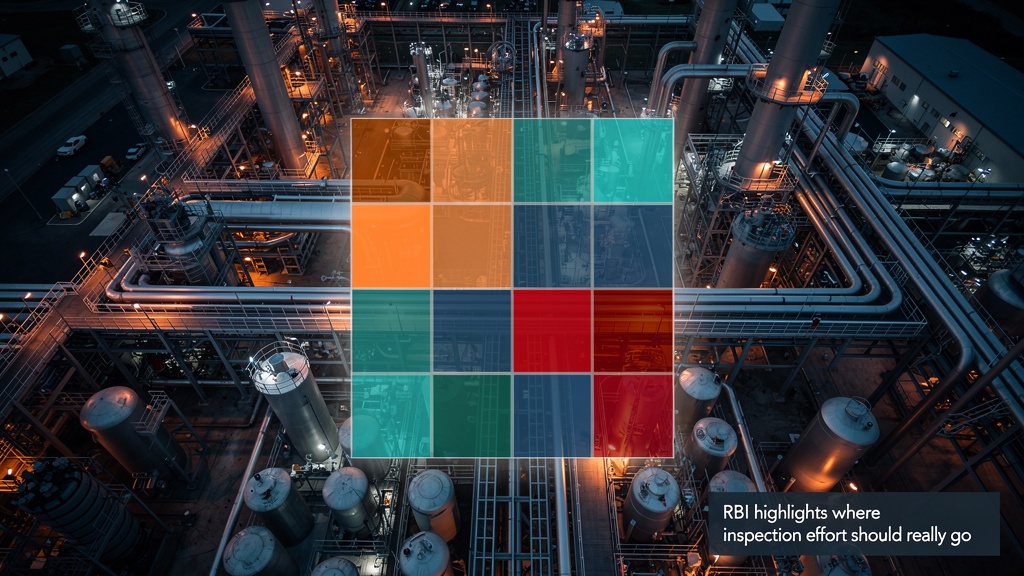
Plot probability and consequence on a risk matrix and assign risk categories such as very high, high, medium and low. RBI experience and case studies show that a minority of equipment usually carries most of the risk. Inspectioneering
Step 6: Adjust inspection plan
Now move from theory into work:
- For high risk items, tighten intervals, improve inspection methods, or add access (for example new nozzles or CMLs).
- For low risk items, consider extending intervals or simplifying scope while staying within code and regulatory limits. Asset Integrity Engineering
Step 7: Implement, monitor and update
Put the new plan into the CMMS, record what you actually find, and refresh the RBI at agreed intervals or after big changes in service. API 580 calls this evergreening
the RBI. LinkedIn
Example: how RBI shifted inspection effort from low risk to high risk circuits
To make this real, consider a simplified case from a mature process unit with three corrosion circuits. The plant originally used time based inspection. Every pressure vessel was opened every turnaround, and selected piping received external checks on the same cycle.
After a first RBI cycle in line with industry practice, the static equipment team saw this: ResearchGate
| Circuit | Description | Dominant damage mechanism | Risk category before RBI | Risk category after RBI |
|---|---|---|---|---|
| A | Light hydrocarbon column system | General thinning, low rate | Treated as critical | Low |
| B | Hot sour separator and piping | Localised corrosion, H₂S | Treated as normal | High |
| C | Condensate storage tank and lines | External CUI and floor corrosion | Treated as normal | Medium |
Once risk was ranked, the inspection plan shifted.
Old time based plan
- All three circuits opened or inspected every turnaround.
- About 1 200 inspection man hours across the three circuits per cycle.
New RBI driven plan
- Circuit A intervals extended and scope reduced.
- Circuit B received more frequent inspections, upgraded NDT and improved access.
- Circuit C received targeted floor and shell inspections plus better CUI checks.
A simple redistribution looked like this:
| Circuit | Old inspection hours per cycle | New inspection hours per cycle |
|---|---|---|
| A | 400 | 150 |
| B | 400 | 650 |
| C | 400 | 400 |
| Total | 1 200 | 1 200 |
The overall hours stayed roughly the same. The difference came from moving 250 hours from low risk Circuit A into high risk Circuit B.
RBI did not magically cut inspection work to zero. It made sure the team stopped over investigating benign circuits while under investigating a high consequence sour service system.
Where Bukom fits into RBI for process plants
Risk based inspection is not only a software or spreadsheet exercise. Someone has to connect risk logic to real assets, construction quality and the way turnarounds actually run.
Bukom Engineering Services focuses on plant design, equipment installation, shutdown services and maintenance support across oil and gas, pharmaceutical and data centre environments in Singapore. Bukom Engineering
For process plants with ageing static equipment, that mix is useful.
Typical RBI support Bukom can provide
By combining Maintenance and Integrity work with project and turnaround support, Bukom can help with: Bukom Engineering
- Cleaning and validating static equipment registers and tags.
- Field verification of vessels, exchangers and piping that do not match drawings.
- Defining inspection friendly corrosion circuits that respect actual construction.
- Planning and executing upgraded NDT and access during shutdowns.
- Closing the loop between RBI findings and repairs or modifications.
You can explore these capabilities through:
- Maintenance and Integrity services
- Engineering and Construction capabilities
- Projects portfolio
- One stop maintenance solutions for critical industries
That way, readers who already understand RBI theory can see how it connects to real work scopes on their site.
Quick FAQ for brownfield RBI
What if my data is incomplete
Most brownfield plants start like that. RBI guidance such as API 580 allows you to use engineering judgement and conservative assumptions, then refine the model as fresh inspection data comes in. PetroSync
The key is to document assumptions and focus early effort where the team already suspects higher risk.
Does RBI replace statutory or code requirements
No. Risk based inspection sits on top of mandatory requirements. Certain equipment must still comply with prescribed code or regulatory intervals. RBI helps you go beyond the minimum by targeting additional inspection where risk justifies it and reducing unnecessary extras elsewhere, while still respecting law and code. Opus Kinetic
How fast does RBI usually pay off
Case studies show that RBI brings value when it avoids major failures and unplanned shutdowns, and when it allows extension of inspection scope on truly low risk items. For a typical process unit, teams often see the first benefits within one or two turnaround cycles, once the plan has been adjusted and executed. MaintWorld
What to do next if you manage old static assets
If you are responsible for ageing vessels, tanks or piping in Singapore process plants, a practical starting list is:
- Choose one unit or system for a first RBI application.
- Confirm the static equipment list and circuits.
- Run a focused risk ranking using realistic damage and consequence inputs.
- Use the results to move inspection hours from low risk to high risk circuits.
- Capture what worked and roll that learning into the next unit.
For plants that prefer to work with an external partner familiar with shutdowns, static equipment and Singapore standards, you can speak with the Bukom team through the contact page and frame RBI as part of your wider maintenance and integrity program. Bukom Engineering