Asset Integrity Management often fails in Singapore for one simple reason. Plans are written for audits, not for inspectors.
In refineries, terminals, chemical plants, and energy facilities across Jurong Island and Tuas, the cost of a weak Asset Integrity Management plan is not theoretical. A single unplanned shutdown caused by pipe failure, tank leakage, or pressure vessel defect can cost tens of thousands per hour, not counting safety exposure.
Bukom Engineering works with plant owners and operators who want Asset Integrity Management that holds up during real inspections, not just during desktop reviews.
This article breaks Asset Integrity Management into an execution-ready structure that inspectors can follow, supervisors can verify, and regulators can accept.
What Asset Integrity Management Really Means in Singapore
Answer capsule
In Singapore, Asset Integrity Management means maintaining pressure vessels, piping, and tanks in a condition that meets MOM statutory requirements while following API inspection codes to prevent loss of containment, unplanned shutdowns, and safety incidents. The focus is execution, documentation, and defect trending, not theory.
Asset Integrity Management in Singapore must balance three forces.
- Strict regulatory oversight
- Aggressive operating conditions
- Limited downtime for inspections
A plan that ignores any of these will fail under pressure.
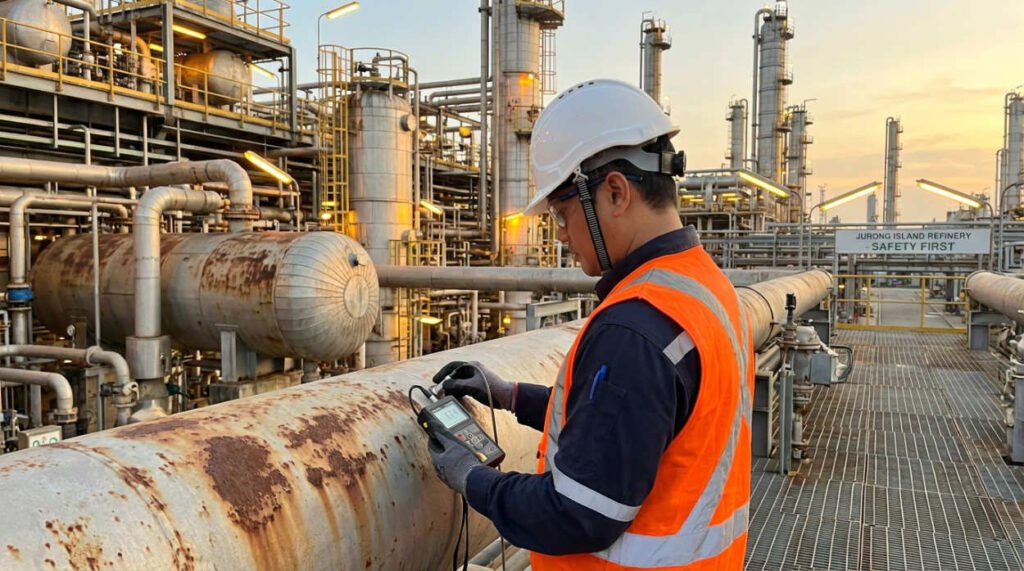
Asset integrity starts at the inspection point: Ultrasonic thickness inspection on live refinery piping
Regulatory Reality. MOM Requirements and API Codes Must Work Together
Many Asset Integrity Management programs fail because they treat compliance and engineering as separate tracks.
In Singapore, this approach does not work.
MOM statutory requirements
The Ministry of Manpower Singapore regulates pressure equipment under the Workplace Safety and Health framework. Certain equipment such as steam boilers, air receivers, and pressure vessels require inspection by an Authorised Examiner at fixed intervals.
These inspections are mandatory. Missing them risks enforcement action and forced shutdowns.
API inspection standards
Internationally accepted inspection practices are defined by the American Petroleum Institute.
Key standards used in Singapore include:
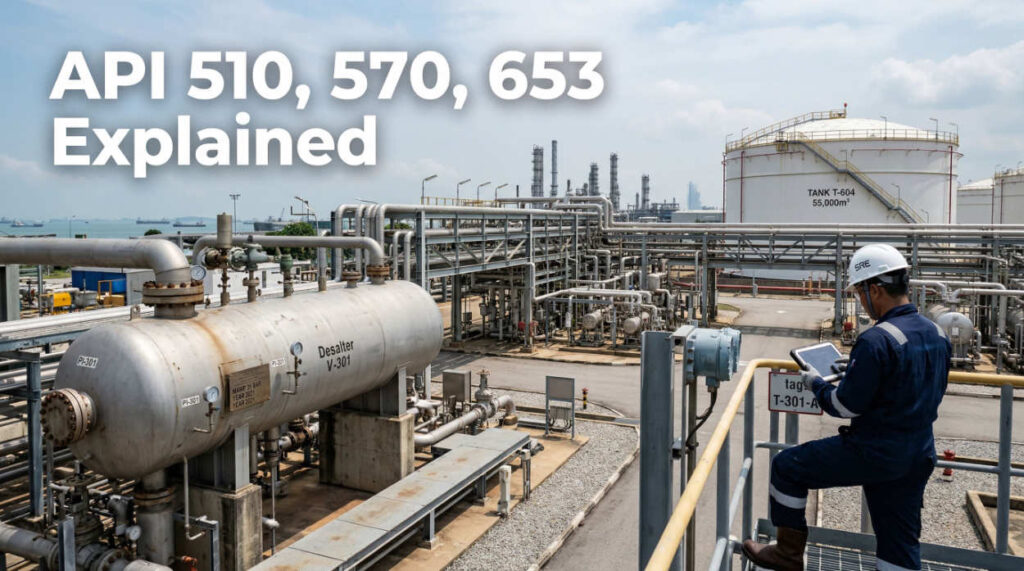
- API 510 for pressure vessels
- API 570 for process piping
- API 653 for aboveground tanks
API codes explain how to inspect, where to inspect, and how to calculate remaining life. MOM defines when statutory inspections must occur.
A working Asset Integrity Management plan connects both.
Core Assets That Must Be Controlled Under an AIM Plan
Asset Integrity Management fails when everything is treated equally. Inspectors need clarity on which assets matter most.
Bukom Engineering structures AIM programs around three critical asset groups.
Pressure Vessels. Beyond Pass or Fail
Pressure vessels are often inspected only to satisfy statutory requirements. This is a mistake.
Under API 510, pressure vessels require:
- Defined inspection intervals
- Identification of damage mechanisms
- Thickness measurement at repeatable locations
- Remaining life calculations
In Singapore, common pressure vessel failure risks include:
- Localized corrosion caused by moisture ingress
- Internal thinning from process fluids
- Weld defects that worsen under cyclic loading
Bukom Engineering assigns fixed Thickness Measurement Locations so inspectors measure the same points every inspection cycle. This allows corrosion rates to be calculated instead of guessed.
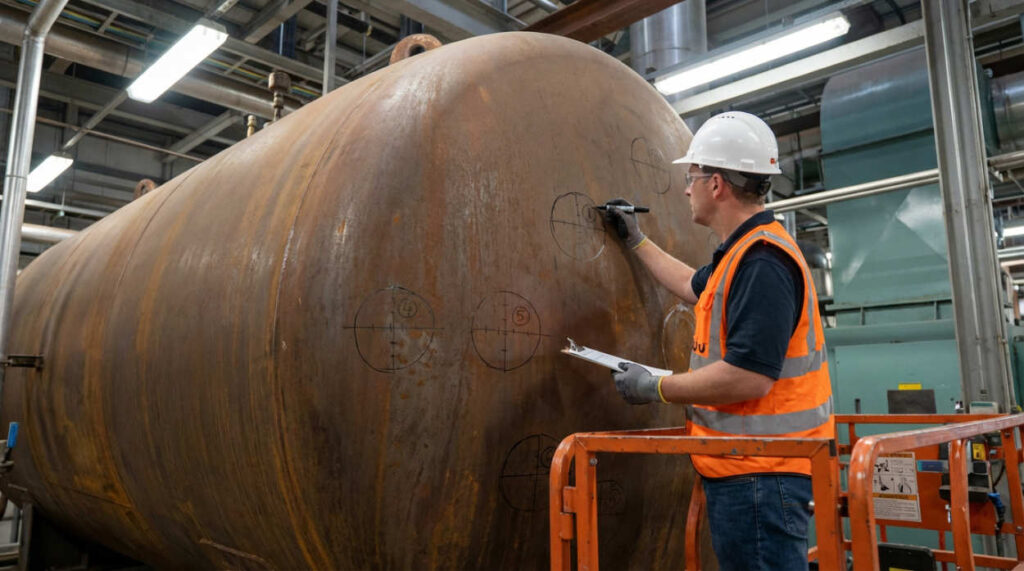
Measure the same point every time: Systematic thickness measurement location marking on pressure vessel shell
Piping Systems. Where Failures Usually Begin
Most loss of containment events in Singapore occur in piping, not vessels.
Under API 570, piping must be divided into circuits based on:
- Fluid type
- Operating temperature
- Corrosion risk
In practice, failures often occur at:
- Dead legs
- Pipe supports
- Low points where water collects
- Under insulation exposed to humidity
Singapore’s climate makes corrosion under insulation one of the most underestimated risks.
Bukom Engineering structures piping inspection circuits so inspectors know exactly where to focus, rather than spreading effort thinly across hundreds of meters of pipe.
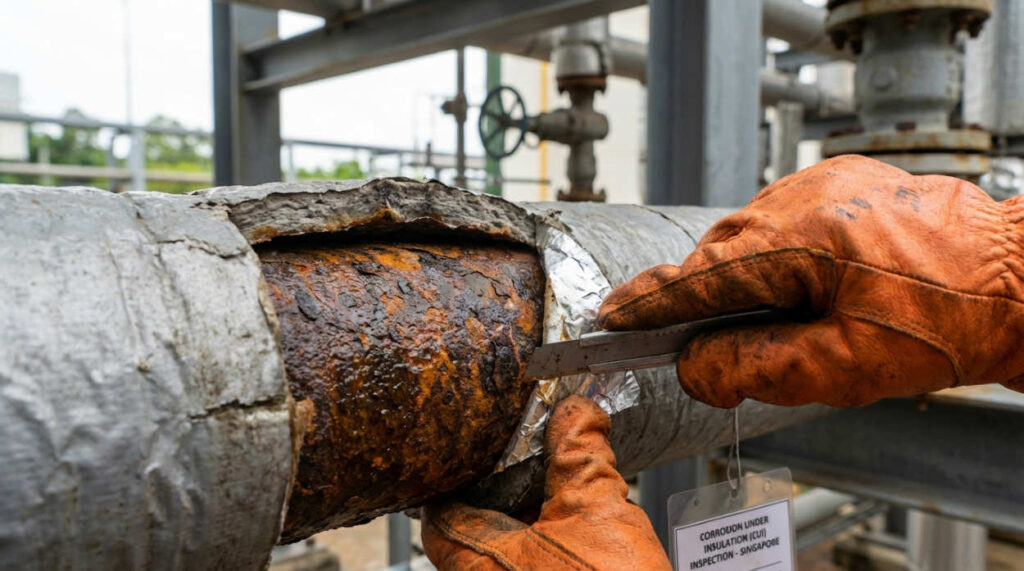
The risk you cannot see: Insulation removed to reveal external corrosion on industrial piping in Singapore’s humid climate
Storage Tanks. Floor Plates Matter More Than Shells
Storage tanks are often visually inspected from the outside. This gives a false sense of security.
Under API 653, tank floors are a critical failure point, especially in coastal and reclaimed areas such as Tuas.
Common risks include:
- Bottom plate corrosion from trapped moisture
- Foundation settlement
- Product leakage undetected by external inspection
Bukom Engineering incorporates Magnetic Flux Leakage scanning into Asset Integrity Management plans to detect bottom side corrosion before leakage occurs.
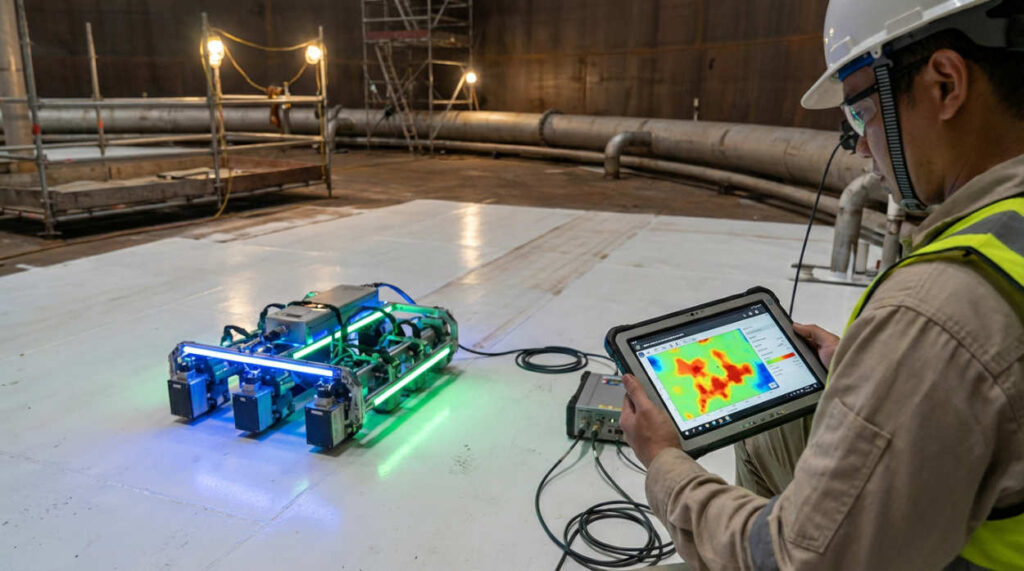
Find corrosion before it leaks: Magnetic flux leakage inspection detecting tank floor corrosion invisible from external inspection
Connecting Inspection Frequency to Real Failure Risk
Fixed inspection intervals are convenient but inefficient.
Asset Integrity Management becomes effective only when inspection frequency reflects actual corrosion rates.
Bukom Engineering applies remaining life calculations defined in API codes by tracking thickness over time. This allows inspectors and engineers to predict when an asset will reach minimum allowable thickness.
Assets with higher corrosion rates are inspected more frequently. Stable assets are inspected less often. This keeps inspection budgets focused where risk is highest.
Why Defect Trending Is More Important Than Inspection Reports
Inspection reports alone do not prevent failures. Trending does.
A single thickness reading has limited value. A series of readings over time reveals corrosion behavior.
Bukom Engineering structures inspection records so inspectors capture data in a consistent format that allows trending.
Comparison of inspection approaches
| Aspect | Traditional inspection | Bukom Engineering AIM approach |
|---|---|---|
| Data capture | One time readings | Repeatable measurement locations |
| Analysis | Pass or fail | Corrosion rate trending |
| Records | Standalone reports | Centralized inspection history |
| Outcome | Repair after leak | Repair before failure |
This structure supports better maintenance planning and more confident regulatory discussions.
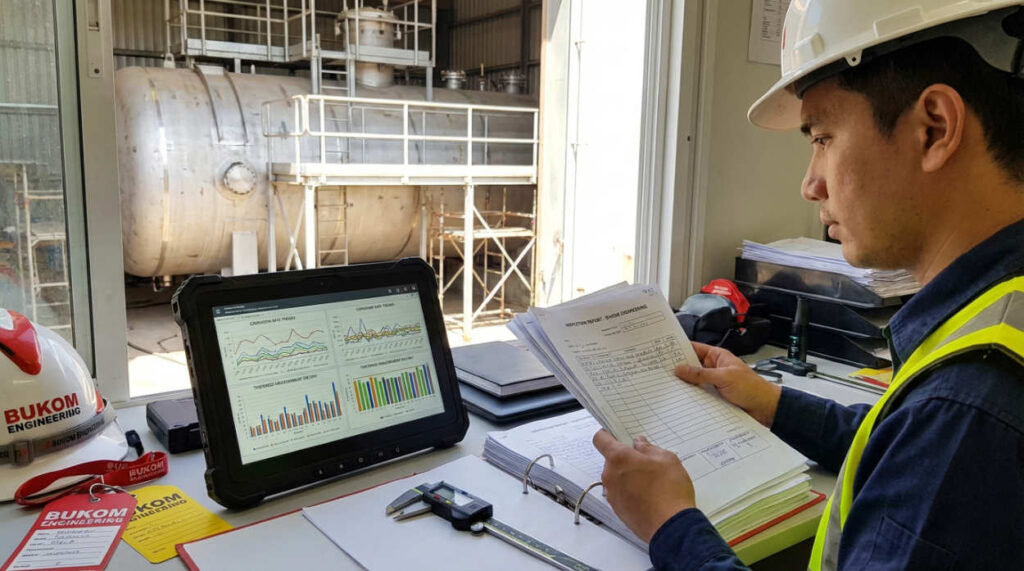
From data to decisions: Systematic inspection data trending enables predictive maintenance and prevents unplanned shutdowns
Documentation That Inspectors Will Actually Use
A common reason Asset Integrity Management fails is document overload.
Inspectors on site need clarity, not manuals.
Bukom Engineering structures AIM documentation into:
- Asset register with inspection scope
- Location specific inspection checklists
- Digital or structured data capture formats
- Clear defect classification guidance
This reduces interpretation errors and improves inspection consistency across teams.
Inspector Competency Matters More Than Templates
Even the best plan fails if inspectors are not qualified.
Asset Integrity Management in Singapore often requires coordination between:
- API certified inspectors
- Non destructive testing technicians
- Professional Engineers
- Authorised Examiners
Bukom Engineering coordinates inspection teams so inspection findings are technically defensible and aligned with regulatory expectations.
This reduces disputes during audits and speeds up approval cycles.
Why Asset Integrity Management Must Be Treated as a Living System
An AIM plan written once and never updated will fail.
Processes change. Fluids change. Operating temperatures change. Corrosion behavior changes.
Bukom Engineering reviews Asset Integrity Management plans periodically to ensure inspection strategies remain aligned with actual plant conditions.
Final Takeaway for Singapore Industrial Operators
Asset Integrity Management succeeds only when it is built for execution.
A working plan:
- Integrates MOM requirements with API codes
- Focuses on high risk assets
- Uses repeatable inspection locations
- Trends defects over time
- Provides inspectors with clear instructions
This approach reduces unplanned shutdowns and gives operators confidence during audits.
Next Step
If you operate pressure vessels, piping systems, or storage tanks in Singapore and want an Asset Integrity Management structure that inspectors can execute without confusion, Bukom Engineering can help you structure a practical inspection program aligned with local requirements.
You can explore related engineering and inspection support directly at https://bukomengineering.com.sg/.
About Bukom Engineering Services Pte Ltd
Bukom Engineering delivers practical Asset Integrity Management solutions for Singapore’s oil & gas, petrochemical, and industrial sectors. Our inspection teams combine API certification, NDT expertise, and local regulatory knowledge to keep critical assets operating safely and reliably.
Skilled Hand. Trusted Service.